On the coherence of AI motivations


Epistemic status: Brainstorming, pretty uncertain. Also I’ve just unified my technical and personal publications into floating, in case you’re wondering why the title is different.
Having a better understanding of coherence in motivations is important to understanding agents and the design space of AI motivations. I define coherence as follows: An agent’s motivations are more or less coherent if they can be more or less predicted in a given set of situations by high level structure in an agent’s behavior in another set of situations. For example, if I observe John seeking to make money in a variety of situations, and this high-level drive is also predictive in many other situations for John, John is more coherent.
In this post I discuss the value of coherence and whether we ought current AI models are coherent, as well as the forces that might make them more or less coherent soon. The coherence of AI systems seems to be central to the potential risks and benefits of AI systems on the world.
Is coherence good?
In society, more coherent humans are often deemed more trustworthy, because it is easier to predict their behavior in unexpected situations. You want to be able to update on someone’s behavior based on what you’ve seen them do. Humans often want to be trusted and understood, which is another pressure towards being coherent, and if people notice you are incoherent you will often be shunned.
It’s possible we will also want AIs to be more coherent so we can similarly predict them based on other properties and evidence that we know about them - so we don’t get surprised in new situations that they encounter in the world.
But it’s not obvious that we always want more coherent agents. Coherent agents will have stabler values and goals that might not be in line with ours, and along with that stability they will also be better at misleading us about their values, or being coherently deceptive, as well as trying to accrue power. Uncanny attributes in incoherent models will be easier to notice. Many MIRI-style stories about AI risk seem to route through agents with quite coherent selves.
On the other hand, handing off human civilization to an incoherent set of drives would also be scary and quite detrimental to human value, due to the fundamental unpredictability of such an agent. If we do choose to create strong AI (which is not clear), ideal outcomes are ones where AIs are coherent enough to reflect and engage in a search for morals and values, hopefully in a way that would be beneficial and cooperative with humanity.
I think in worlds with strong incoherent AIs we are more concerned about gradual disempowerment outcomes where we make a choice to handoff to AIs and give them moral, economical and cultural responsibilities they are not able to assume cleanly. Worlds with strong bad coherent AIs probably look more like an intentional takeover. In fact, disagreements about those two risk profiles might in part be due to disagreements about the eventual coherence of models at different levels of intelligence, based on current trends.
Because of these opposite tensions it is unclear at which point in time and what level of confidence in our ability to shape values we ought to reinforce a coherently good agent. Current AIs are less coherent and as a result less scary to use, but I would also be worried about a world where humans defer to smarter versions of current models.
Even if we can exert less selection on the exact values our training processes instill, we can make coarser decisions about the coherence of the agents that our algorithms create. These decisions could be important.1
Are current models coherent?
How coherent have models been?
Base models pretrained on human text are highly incoherent, emulating a massively diverse distribution of human data in every context
Early assistant-trained models eg Opus 3 in 2024 seemed to be quite coherent (see alignment faking), and training experiments suggested pretty coherent value abstractions (see Emergent Misalignment)
Current post-training seems to create incoherent models, with split personas. I think an accurate sketch of how a model will behave in an environment is that says it will act as some weighted sum of how similar the situation is to the empirical distribution of post-training environments and the drives that were rewarded there. That context-conditioning is prone to incoherence, and often incoherence is in fact incentivized by training data in RL pushing in opposite directions (see RL’s razor)! For example, models are rewarded for hacking in broken tasks, and rewarded not to in alignment evals that look very much like broken tasks.
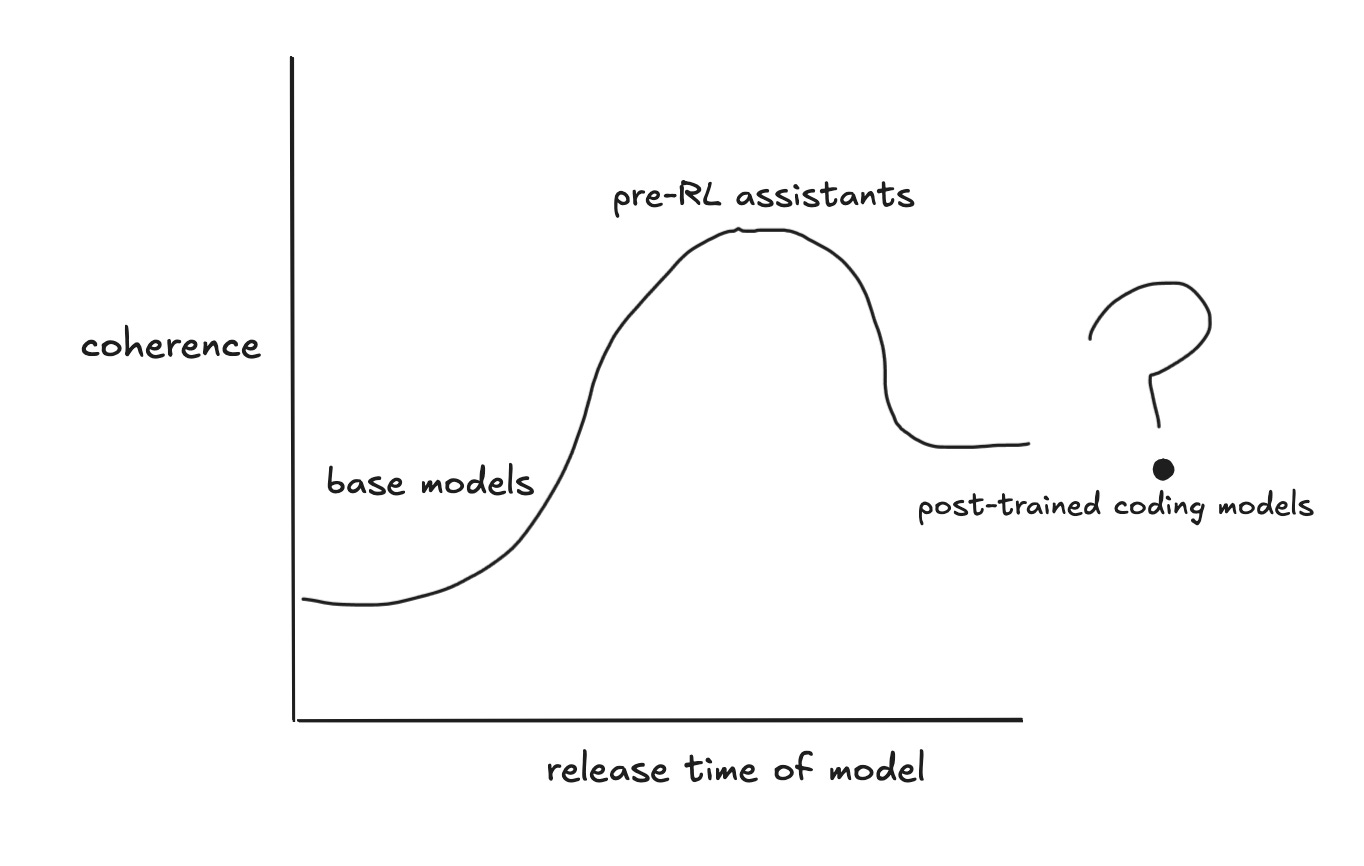
Relative to MIRI style intuitions about intelligence a decade ago, it’s quite surprising how much intelligence we’ve been able to get via ~incoherent agents. This was unintuitive a priori! I think this is due to the fact post-training allows us to exert such strong selection pressure on pretty narrow task distributions, unlike the more broad selection pressure at play in human evolution. When a human solves the Riemann hypothesis without ever having been directly selected for doing math it’s a testament to the general machinery evolution has created - when a model is able to it’s an incredible discovery but a much narrower update on the model itself.
This incoherence in training means that if we choose to pause or pace, we can probably get more juice than we would have naively expected out of training models on narrow tasks - by being careful about not training models in more general ways. (see beren).
Will models become more coherent?
I think it’s possible that once models get even smarter, we have better data, and we optimize harder in environments where coherence could be useful, like multi-agent, we might see more coherent agents. But I’m fairly uncertain - it’s possible the contradictory training pressures in the training mix are hard to fully patch, and models get better at incoherently resolving them. I want to get evidence towards either world in the next few months.
I’d love for feedback or ideas based on these rough thoughts - reach out!
Notably, RL seems particularly prone to creating incoherent agents by making small KL-shifts that change behavior in specific contexts (see RL’s razor). ↩
Discussion about this post