D’où je viens - where I come from

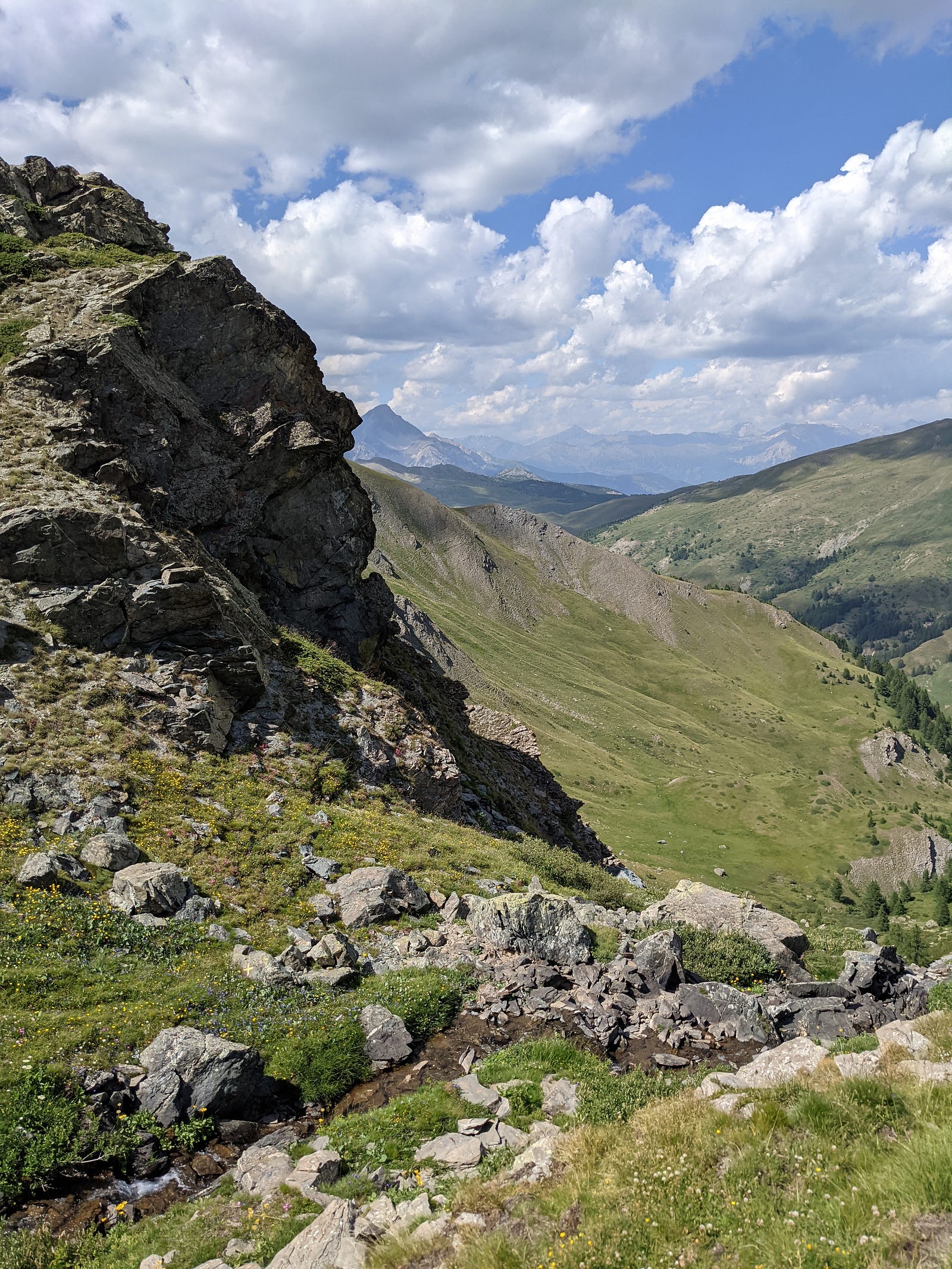
See here for English translation, LLM-assisted by Echo.
Je pensais ce soir à ma famille, et à l’idée d’un canon – d’un ensemble d’influences ou d’œuvres qui constitue le principe de quelque chose. De quoi est-on fait ? Quelles idées, quelles personnes sont inévitables pour comprendre le corps et l’âme que l’on est devenu ?
Je contemple alors évidemment ce soir l’histoire de ma famille, de ma mère, de mon grand-père, de la France, une France un peu trop rose, idéaliste, amoureuse d’intensité, qui cherche à tout comprendre mais s’arrête en route le temps d’admirer la vue. Maintenant je suis à San Francisco, dans un autre pays où peu de mes amis connaissent vraiment cet héritage, les histoires qui m’ont porté là où je suis maintenant. J’ai peur parfois de perdre le fil d’où je viens, de perdre cette langue et sa familiarité, et je veux donc exprimer mes racines.
Mon grand-père était un physicien connu pour son travail sur les cristaux liquides et les polymères. Il est mort quand j’avais deux ans, donc je le connais très peu. Ce traumatisme pour ma famille colora ma petite enfance, ma mère voulant à tout prix exprimer et faire vivre les valeurs de son père à travers son fils et son éducation.
Mon grand-père a été élevé par sa mère. Sa mère avait une force de vie folle, et l’a instruit seule dans les Alpes pendant plusieurs années. Il a été marqué par la guerre, où il a failli la perdre aux mains des nazis. Elle avait de grandes ambitions pour lui, qu’il réalisera.
Il n’était pas un homme parfait, et dans sa vie personnelle il a parfois gravement manqué. Mais à beaucoup d’égards, la conception que j’ai des buts que je me fixe, des idéaux qui m’animent, semble, quand j’y réfléchis, s’ancrer inconsciemment dans son parcours.
C’était un grand scientifique, qui savait trouver des modèles simples pour expliquer des phénomènes compliqués, et essayait toujours d’aller droit au but pour comprendre le monde. Il voulait trouver des explications simples et élégantes, qu’il aurait pu communiquer clairement même à des lycéens – plus tard dans sa carrière, il fera le tour des lycées de France pour parler aux jeunes et leur communiquer son amour pour la science. Je me rappelle avoir revu des vidéos où il explique la dynamique du sable sur une dune.
Son approche de la science semble aussi avoir été portée par l’art : il dessinait, faisait des croquis, lisait de la littérature et de la philosophie. Il se baladait dans la montagne, skiait et nageait ; il voulait parcourir le monde, et voyageait beaucoup, voulant comprendre et apprécier l’étendue du genre humain. Il a voulu creuser le lien entre la science et l’industrie, et pousser l’application de ses idées dans l’industrie.
J’ai l’impression qu’il avait pour but de faire de sa vie une œuvre, une œuvre qui aurait mêlé la science, l’art, la politique et même une touche de spirituel, une œuvre qui, d’un trait, aurait suggéré les causes, la structure et la beauté de ce monde. 1
On manque aujourd’hui d’esprits qui ont une telle ambition, qui y mettent leur cœur sans trop d’ironie, qui veulent donc embrasser les deux cultures : comprendre les lois du monde sans renoncer à son immensité, avoir la sensibilité nécessaire pour apprécier la beauté des choses, et ne pas renoncer à la quête de vérité et de science. Cette vision, cet équilibre entre deux forces, est au cœur de ma vie et de mes origines.
Mes grands-parents allaient souvent à la montagne, ayant tous les deux des origines dans les Alpes. Mon grand-père se levait alors tôt le matin pour faire de la science, écrire et envoyer des manuscrits, puis il s’élançait sur les pistes et dans la neige, pour voir le soleil sur les pics dans l’après-midi et planter ses bâtons à terre. Les montagnes, ce que j’ai de ma famille, d’où je viens, me manquent. J’aimerais y aller ensemble, faire la marche vers le sommet, revivre les discussions, les jeux, les histoires, les énigmes, et puis encore la montagne, qui nous apprend le silence, nous apprend à être un soupir dans le vent face aux hautes idées de la nature.
Quand j’y suis, je pense parfois à lui, et au plaisir que j’aurais à lui parler, dans les lacets du sentier, de ma vie, de ce que je suis devenu ; à entendre ce qu’il était vraiment, plutôt que mes idées romantiques. À lui expliquer vraiment qui je suis et ce que j’aime. À parler de science, de films et de poèmes.
La vie est trop courte pour se perdre, pour oublier d’où l’on vient et où l’on aimerait vraiment aller. Je suis donc mon chemin, je l’ancre dans mon histoire, sans qu’elle empêche ma soudaine transformation.
Amusons-nous sur la terre et sur l’onde
Malheureux qui se fait un nom
Richesses, honneurs, faux éclats de ce monde
Tout n’est que bulles de savon.
– Jean Daullé
English - Where I Come From
I’ve been thinking tonight about my family, and about the idea of a canon: that set of influences or works which forms the principle of something. What are we made of? Which ideas, which people are indispensable to understanding the body and soul we have become?
So tonight my mind naturally turns to the history of my family, of my mother, of my grandfather, of France—a France perhaps a little too rosy, too idealistic, drunk on intensity, that wants to understand everything but cannot help stopping along the way to admire the view. Now I am in San Francisco, in another country where few of my friends really know this inheritance, the stories that carried me to where I am now. Sometimes I am afraid of losing the thread of where I come from, of losing this language and its familiarity, and so I want to try to express my roots.
My grandfather was a physicist known for his work on liquid crystals and polymers. He died when I was two, so I know very little of him. But his death was a trauma for our family that colored my early childhood; my mother wanting to express and keep alive her father’s values through her son, through my education.
My grandfather was raised by his mother. She had a wild force of life, and taught him alone in the Alps for several years. He was marked by the war, in which he almost lost her at the hands of the Nazis. She had great ambitions for him, which he would fulfill.
He was not a perfect man, and in his personal life he sometimes failed seriously. But in many ways, when I think about the goals I set for myself and the ideals that animate me, I find they seem to have unconsciously anchored themselves in his journey.
He was a great scientist, who knew how to find simple models to explain complicated phenomena, and always tried to get straight to the point in understanding the world. He looked for elegant explanations, the kind he could communicate clearly even to high schoolers; later in his career he would tour the lycées of France to talk to young people and share his love for science with them. I remember watching videos in which he explains the dynamics of sand on a dune.
His approach to science also seems to have been carried by art: he drew, sketched, read literature and philosophy. He wandered in the mountains, skied and swam; he wanted to travel the world, and did so widely, wanting to understand and appreciate the breadth of humankind. He wanted to to push the application of his ideas into industry.
It seems to me that he wanted to make his life into a work of art: a work that would mix science, art, politics, and even a touch of the spiritual; a work that in a single stroke would have suggested the causes, the structure, and the beauty of this world.
It seems to me that today we somtimes lack people with such ambitions, that so much of their heart into their lives without fearing irony, that want to embrace the two cultures: to understand the laws of the world without renouncing its immensity, to have the sensitivity necessary to appreciate the beauty of things, and to not give up on the quest for truth and science. This vision, this balance between two forces, is at the heart of my life and where I come from.
My grandparents often went to the mountains, both of them having roots in the Alps. My grandfather would get up early in the morning to do science, to write and send off manuscripts, and then he would dash onto the slopes and into the snow, to see the sun on the peaks in the afternoon and plant his poles in the ground. The mountains, what I have of my family, where I come from—I miss them. I would like to go there together, to make the walk to the summit, to relive the discussions, the games, the stories, the riddles, and then the mountain again, to be a sigh in the wind before nature’s high ideas.
When I am there, I sometimes think of him, and of the pleasure I would have talking to him in the switchbacks of the trail about my life, about what I have become. I want to hear what he really was, rather than my romantic notions of him. I want to explain to him who I am and what I love. To talk about science, films, and poems.
Life is too short to get lost, to forget where we come from and where we would really like to go. So I follow my path and sometimes anchor it in this story, without letting it prevent my sudden transformation.
Let us amuse ourselves on earth and on the wave
Wretched who makes a name for himself
Riches, honors, false splendors of this world
All is but soap bubbles.
– Jean Daullé
Un de mes livres preferes, La Promesse de l’aube de Romain Gary, me rappelle de ma famille et de la vie de mon grand-pere:
Je sais que le talent de ma mère m’a longtemps poussé à aborder la vie comme un matériau artistique et que je me suis brisé à vouloir l’ordonner autour d’un être aimé selon quelque règle d’or. Le goût du chef-d’œuvre, de la maîtrise, de la beauté me poussait à me jeter les mains impatientes contre une pâte informe qu’aucune volonté humaine ne peut modeler, mais qui, elle, possède au contraire le pouvoir insidieux de vous pétrir à sa guise, imperceptiblement
awww
wauw